 548787ac8a
W0110: when a function marked `inline` has a body shape the IR
lowerer can't splice (conditional early return, loops, nested
control flow, empty void body), the analyzer now emits a
warning at the declaration site so the declined hint is
visible instead of silently falling back to a regular JSR.

Implementation:
  - New `W0110` error code in `src/errors/diagnostic.rs` (warning level).
  - New `pub fn can_inline_fun(return_type, body) -> bool` in
    `src/ir/lowering.rs`, extracted from the existing capture
    logic so the analyzer and the IR lowerer share the same
    eligibility rules and can never drift.
  - New `check_inline_declinability` analyzer pass called from
    the tail of `analyze_program`, mirroring the existing
    `check_sprite_scanline_budget` / `check_unreachable_states`
    passes. Emits W0110 with help + note text pointing at the
    two accepted body shapes.
  - `capture_inline_bodies` now defers to `can_inline_fun`
    instead of duplicating the match pattern, so the two sides
    stay in lockstep by construction.

Four regression tests in `src/analyzer/tests.rs` cover the
conditional-return and while-loop declines plus the two
accepted shapes (single-return expression, void sequence).

Example source cleanups: `wrap52` in `examples/war/deck.ne`
and `abs_diff` in both `examples/arrays_and_functions.ne` and
`examples/loop_break_continue.ne` drop the `inline` keyword.
All three were dead hints — the `inline` was being silently
declined before this change, so removing it is source-only;
the three ROMs are byte-identical, all 32 emulator goldens
still match.

Docs refresh
  - `docs/language-guide.md`: rewrote the Inline Functions section
    (real behaviour + W0110), added W0105/W0106/W0107/W0108/W0109/
    W0110 to the warnings table, added the `debug.sprite_overflow*`
    builtins + sprite-per-scanline mitigations section to the
    Debug Mode docs, added a `cycle_sprites` statement entry and
    cross-referenced it from `draw`.
  - `docs/nes-reference.md`: fleshed out the "NEScript Memory
    Usage" block with the full ZP + high-RAM layout, including
    the new `$07EF` / `$07FC` / `$07FD` slots for sprite cycling
    and the debug sprite-overflow telemetry.
  - `docs/future-work.md`: documented all four debug query
    builtins in the "What ships today" block; updated the open
    "OAM allocation strategy" question to reference the shipped
    `cycle_sprites` path and ask about an automatic-flicker
    game attribute as a follow-up.
  - `docs/architecture.md`: updated the `ir/` and `optimizer/`
    module summaries to describe real inline splicing (now
    in lowering, not the optimizer).
  - `README.md`: reframed the `inline` bullet from "hint" to
    "real splicing for single-return / void-body shapes";
    expanded the debug-support bullet to mention the four
    query builtins and their stripping in release builds; added
    a new bullet for the three-layer sprite-per-scanline
    mitigations; bumped the test count from 497 → 694; updated
    the war.ne entry to mention the seven compiler bugs are all
    fixed and point readers at `git log` (instead of the
    deleted COMPILER_BUGS.md).
  - `examples/README.md`: same `git log`-pointing rewrite for
    the war.ne entry.

Deletions
  - `examples/war/COMPILER_BUGS.md` is removed. All seven
    catalogued bugs are fixed; the file's historical value
    lives in `git log` now. Every source-code comment and doc
    reference to the file has been updated to either point at
    `git log` or just describe the bug in place.

Test count: 616 unit + 75 integration + 3 doctests = 694 total.
Clippy / fmt clean. 32/32 emulator goldens match.

https://claude.ai/code/session_0143dTgh3UeRrtfHgQwzcv5z
9.9 KiB
NEScript
A statically-typed, compiled programming language for NES game development.
NEScript compiles .ne source files directly into playable iNES ROM files, with no external assembler or linker dependencies. The compiler handles everything from source text to a ROM you can run in any NES emulator.
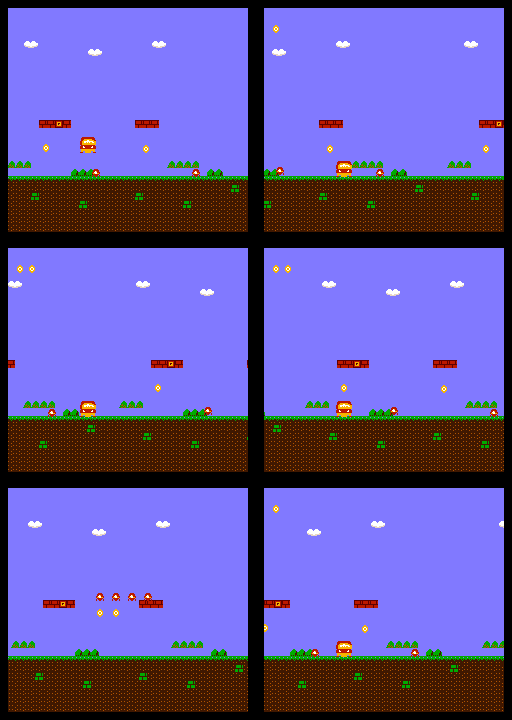
Source: examples/platformer.ne
Quick Start
# Build the compiler
cargo build --release

# Compile an example
cargo run -- build examples/hello_sprite.ne

# Run the output ROM in an emulator
# (produces examples/hello_sprite.nes)
Hello World
game "Hello" {
    mapper: NROM
}

var px: u8 = 128
var py: u8 = 120

on frame {
    if button.right { px += 2 }
    if button.left  { px -= 2 }
    if button.down  { py += 2 }
    if button.up    { py -= 2 }

    draw Smiley at: (px, py)
}

start Main
Features
- Game-aware syntax -- states, sprites, palettes, backgrounds, and input are first-class constructs
- Full type system --
u8,i8,u16,bool, fixed-size arrays (u8[N]),enum,struct - Rich control flow --
if/else,while,for i in 0..N,loop,match - Functions -- with parameters, return types, real
inline funsplicing for single-return and void-body shapes, recursion detection - State machines --
statewithon enter,on exit,on frame,on scanline(N)handlers - Compile-time safety -- call depth limits, recursion detection, type checking, unused-var warnings
- IR-based optimizer -- constant folding, dead code elimination, strength reduction (incl. div/mod by power-of-two), copy propagation, peephole passes including INC/DEC fold and live-range slot recycling
- Full 16-bit arithmetic -- u16 add/sub/compare lower to carry-propagating paired operations
- Multiple mappers -- NROM, MMC1, UxROM, MMC3 (including multi-scanline IRQ dispatch per state)
- Audio subsystem -- frame-walking pulse driver with user-declared
sfx/musicblocks, builtin effects and tracks, period table, and zero-cost elision when unused - Palette & background pipeline --
paletteandbackgroundblocks, initial values loaded at reset, vblank-safeset_palette/load_backgroundruntime swaps - Asset pipeline -- PNG-to-CHR conversion, inline tile data, sfx envelopes, music note streams
- Inline assembly --
asm { ... }with{var}substitution, plusraw asm { ... }for verbatim blocks - Hardware intrinsics --
poke(addr, value)/peek(addr)for direct register access - Debug support --
--debugflag enablesdebug.log/debug.assert, runtime array bounds checks, frame-overrun and sprite-overflow counters, and thedebug.frame_overrun_count()/debug.frame_overran()/debug.sprite_overflow_count()/debug.sprite_overflow()query builtins — all stripped entirely in release builds - Sprite-per-scanline mitigations -- three layers of defense for the NES's 8-sprites-per-scanline hardware limit: compile-time
W0109static check for literal layouts, runtimecycle_spritesflicker intrinsic for dynamic scenes, and debug-mode telemetry viadebug.sprite_overflow()for playtest assertions - Compile-time diagnostics --
--dump-ir,--memory-map,--call-graphflags - Single binary -- no dependencies on ca65, Python, or any external tools
Documentation
- Language Guide -- complete reference for every language feature
- Architecture -- compiler internals and module overview
- NES Reference -- hardware quick reference for contributors
- Examples README -- how to build and run examples
Examples
| Example | Features demonstrated |
|---|---|
hello_sprite.ne |
D-pad input, sprite drawing |
bouncing_ball.ne |
Automatic movement, edge detection |
coin_cavern.ne |
Multi-state game, functions, constants, gravity |
arrays_and_functions.ne |
Arrays, functions, while loops, inline functions |
state_machine.ne |
State transitions, on enter/exit, timers |
sprites_and_palettes.ne |
Inline CHR data, scroll, type casting |
mmc1_banked.ne |
MMC1 mapper, bank declarations, multiply |
uxrom_user_banked.ne |
UxROM mapper with a bank Foo { fun ... } block — first example to put real user code in a switchable bank, called via a generated cross-bank trampoline |
uxrom_banked_to_banked.ne |
UxROM with two bank Foo { fun ... } blocks — exercises a banked→banked call (step in Logic calls clamp in Helpers) routed through the same trampoline that handles fixed→banked |
palette_and_background.ne |
Palette and background declarations, reset-time load, vblank-safe set_palette / load_background swaps |
auto_chr_background.ne |
background Stage @nametable("file.png") with automatic CHR generation — the resolver dedupes the PNG's 8×8 cells, encodes them as 2-bitplane CHR, and slots them into CHR ROM after the sprite tile range |
friendly_assets.ne |
Pleasant asset syntax — named NES colours, grouped bg0..sp3 palettes with universal:, ASCII pixel-art sprites, legend { } + map: tilemaps, palette_map: attribute grids, scalar sfx pitch:, note-name music with tempo: |
structs_enums_for.ne |
Structs, enums, for loops, struct literals |
nested_structs.ne |
Nested-struct fields (hero.pos.x) and array struct fields (hero.inv[0]) with chained literal initializers |
inline_asm_demo.ne |
Inline asm with {var} substitution, poke/peek |
audio_demo.ne |
Audio subsystem: user sfx/music blocks, builtin effects, play/start_music/stop_music |
noise_triangle_sfx.ne |
Noise and triangle channel sfx via channel: noise / channel: triangle on sfx blocks |
sfx_pitch_envelope.ne |
Per-frame pulse pitch: arrays — the audio tick walks the pitch envelope in lockstep with the volume envelope and writes $4002 on every NMI for a frequency-sweeping siren tone |
metasprite_demo.ne |
metasprite Hero { sprite: ..., dx: [...], dy: [...], frame: [...] } declarative multi-tile groups — draw Hero at: (x, y) expands to one OAM slot per tile so 16×16 sprites stop needing four hand-written draw statements |
sprite_flicker_demo.ne |
cycle_sprites — rotates the OAM DMA start offset one slot per frame so scenes with more than 8 sprites on a scanline drop a different one each frame. Turns the NES's permanent sprite-dropout hardware symptom into visible flicker, which the eye reconstructs from adjacent frames. Pairs with the compile-time W0109 warning and the debug-mode debug.sprite_overflow() / debug.sprite_overflow_count() telemetry for a three-layer defense against the 8-sprites-per-scanline limit. |
platformer.ne |
End-to-end side-scroller — custom CHR tileset, full background nametable, metasprite player with gravity/jump physics, wrap-around scrolling, stomp-or-die enemy collisions, live stomp-count HUD, pickup coins, user-declared SFX + music, and a Title → Playing → GameOver state machine with a proximity-based autopilot so the headless harness demonstrates the full gameplay loop (stomp, stomp, die, retry) inside six seconds |
war.ne |
Production-quality card game — a complete port of War split across examples/war/*.ne: title screen with a 0/1/2-player menu, animated deal, sliding face-up cards, deck-count HUD, "WAR!" tie-break with buried cards, victory screen with a fanfare, and a brisk 4/4 march on pulse 2. Pulls in nearly every NEScript subsystem (custom 88-tile sheet, felt nametable, 8-bit LFSR PRNG, queue-based decks, phase machine inside Playing, multiple sfx + music tracks). Building it surfaced seven compiler bugs, all fixed on the same branch — see git log for the details. |
Compiler Commands
# Compile to ROM
nescript build game.ne

# Compile with custom output path
nescript build game.ne --output my_game.nes

# Type-check only (no ROM output)
nescript check game.ne

# View generated 6502 assembly
nescript build game.ne --asm-dump

# Enable debug mode
nescript build game.ne --debug
Emulator Compatibility
Output ROMs are standard iNES format and work with any NES emulator:
Project Status
NEScript implements all five planned milestones:
| Milestone | Status | Key Features |
|---|---|---|
| M1: Hello Sprite | Done | Full compiler pipeline, assembler, ROM builder |
| M2: Game Loop | Done | Functions, arrays, IR, optimizer, call graph analysis |
| M3: Asset Pipeline | Done | PNG-to-CHR, sprites, debug.log / debug.assert |
| M4: Optimization | Done | Strength reduction, ZP promotion, type casting, asm-dump |
| M5: Bank Switching | Done | MMC1/UxROM/MMC3, bank declarations, software mul/div |
694 tests across the lexer, parser, analyzer, IR, optimizer, codegen, assembler, linker, runtime, ROM, and asset modules, plus a pixel- and audio-exact emulator harness that captures a golden framebuffer + audio hash for every example. CI runs fmt, clippy, test, example compilation, and the emulator harness on every push.