
7.7 KiB
Foldable snub dodecahedron net
Generate a 3D-printable flat net of a snub dodecahedron that you print in one (or a few) flat pieces, then fold along beveled hinges and glue into the finished Archimedean solid.
This was inspired by the Wikipedia net
Snub_dodecahedron_flat.svg.
Rather than tracing that bitmap-ish SVG, the geometry here is generated from the
exact coordinates of the snub dodecahedron, so every face is a perfect
regular polygon and every fold angle is computed from the solid's true dihedral
angles.

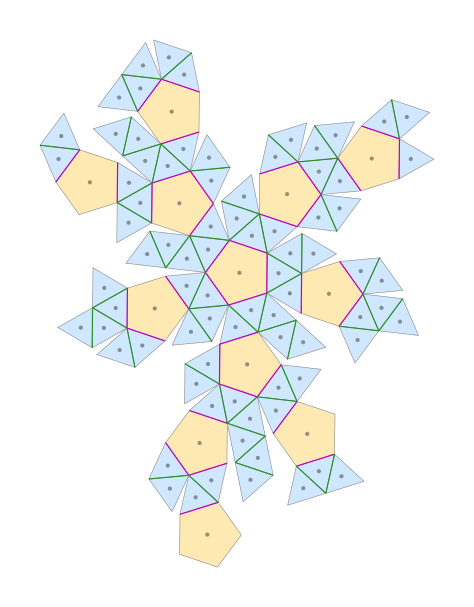
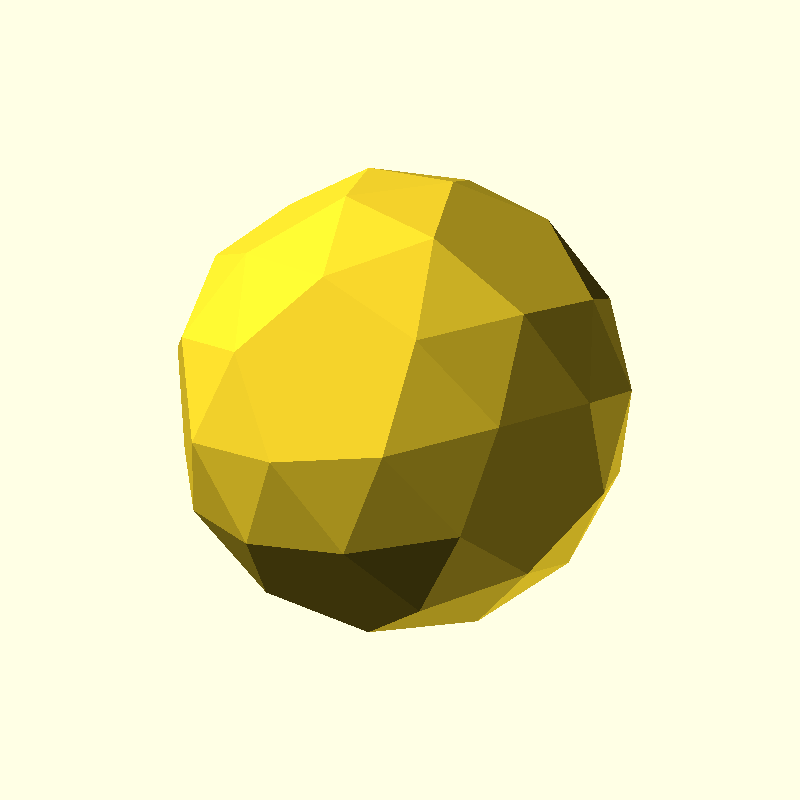
| The flat net (one piece) | A single fold groove | Folds into this |
|---|---|---|
 |
 |
 |
The 92 faces (12 pentagons + 80 triangles) unfold into a single non-overlapping net with 91 fold hinges and 59 glue seams. Pentagons are shown orange, triangles blue; green fold lines are triangle–triangle edges and magenta fold lines are triangle–pentagon edges.
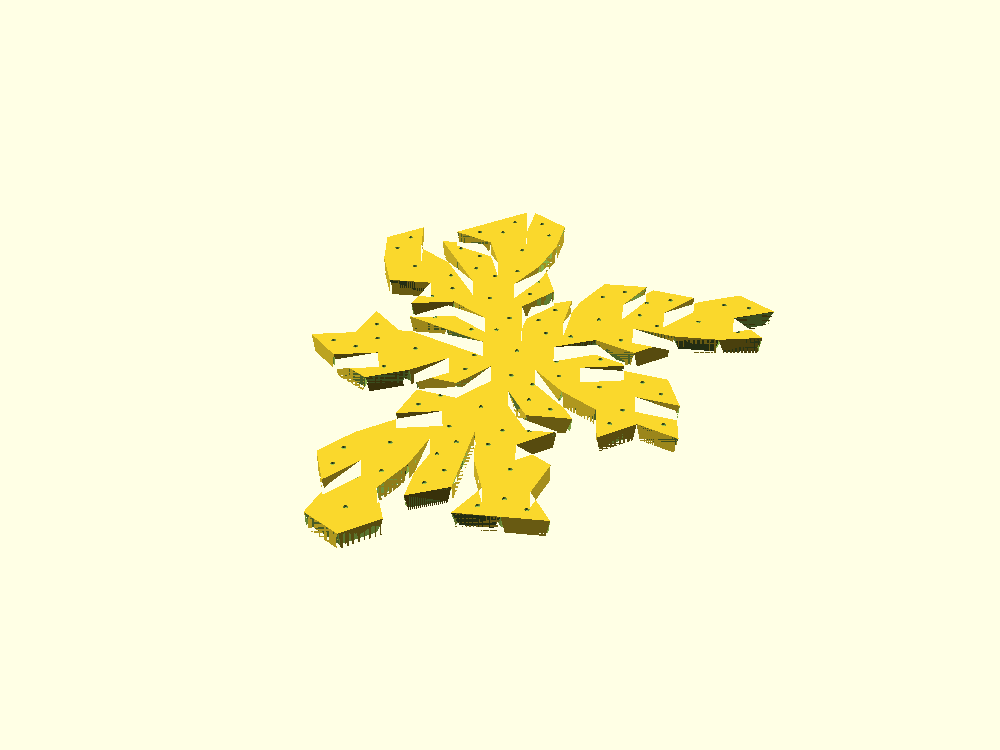
The actual generated 3D plate (grooves cut on the inner side):
How the folding works
The net prints as a flat plate of thickness T:
 z = T   outer surface of the finished solid  (stays continuous over folds)
 z = 0   inner surface                        (the V-grooves open here)
To fold two adjacent panels from flat (180°) to the solid's interior dihedral
angle θ, a V-groove is removed from the inner side along the shared edge.
When the groove closes, the panels sit at θ. A thin web of material is
left at the top as a living hinge.
fold angle  = 180° − θ
each groove wall is cut at   γ = (fold + slack) / 2   from vertical
groove half-width at base    w = (T − web) · tan(γ)
The snub dodecahedron has exactly two distinct dihedral angles, so two groove sizes are produced automatically:
| Edge type | Dihedral θ |
Fold (180−θ) |
|---|---|---|
| triangle–triangle | 164.175° | 15.825° |
| triangle–pentagon | 152.930° | 27.070° |
slack (default 6°) makes every groove slightly wider than strictly
necessary. The panels can then always reach θ — in fact they can over-close
by slack degrees — so any small gap at the target angle is simply filled with
glue. This follows the "leave more room than necessary" bias: it is far easier
to fill a gap with glue than to fight a groove that closes too early.
Glue seams (edges where two far-apart parts of the net meet only after folding)
are chamfered on each mating face by the same γ, so the two faces end up
coplanar and glue flush at the correct angle.
Requirements
This project is run with uv. The Python scripts
carry inline dependency metadata (PEP 723),
so uv run automatically creates an isolated environment with numpy/scipy
on first use — there is nothing to install manually.
# install uv (see https://docs.astral.sh/uv/getting-started/installation/)
curl -LsSf https://astral.sh/uv/install.sh | sh    # or: pip install uv

# OpenSCAD is only needed to render STLs (the .scad is written regardless)
sudo apt-get install openscad                      # or https://openscad.org
Usage
# default: 30 mm edges, 12 mm thick, magnet pockets, single net -> out/snub_net.scad
uv run generate.py

# pick your own size/depth and also render an STL
uv run generate.py --edge 35 --depth 14 --web 0.4 --slack 6 --stl

# split into smaller pieces (≤ 20 faces each) for easier printing/handling
uv run generate.py --max-faces-per-piece 20 --stl

# also export the target solid as a reference model
uv run generate.py --solid
Open the generated .scad in OpenSCAD (or use --stl) to get a mesh, then
slice and print.
Parameters
| Flag | Default | Meaning |
|---|---|---|
--edge |
30 |
edge length of every polygon (mm) — sets overall size |
--depth / --thickness |
12 |
plate depth / material thickness T (mm) — thick, rigid panels |
--web |
0.4 |
living-hinge web left at the top of each groove (mm), ~1–2 print layers |
--slack |
6 |
extra fold opening added to every groove (degrees) |
--over |
0.4 |
run grooves this far past each vertex for a clean fold (mm) |
--magnet-diameter |
3.175 |
magnet pocket diameter (mm) — default 1/8 in |
--magnet-depth |
1.5875 |
magnet pocket depth (mm) — default 1/16 in |
--no-magnets |
off | do not pocket magnet holes in the faces |
--max-faces-per-piece |
— | split the net into pieces of at most N faces |
--no-boundary-bevel |
off | leave glue-seam edges square instead of chamfered |
--solid |
off | also export the reference snub dodecahedron solid |
--stl |
off | render an STL via the openscad CLI |
--out |
out/snub_net |
output path prefix |
Printing & assembly
- Orientation: print the plate inner (grooved) side down on the bed.
Every bevel wall is within ~
γof vertical (< ~20°), so the grooves are self-supporting — no support material needed. - Material: PLA/PETG work. The default
--web 0.4(≈1–2 layers at a 0.2 mm layer height) leaves a thin, easy-to-bend living hinge between the thick rigid panels. Set your slicer's layer height so the web is a whole number of layers (e.g. 0.4 mm web at 0.2 mm layers). For repeated folding or brittle filament, increase--web; for an even easier single fold, drop it toward one layer. - Fold each hinge until the groove walls meet (or until the faces look right). The grooves are valley folds toward the inner side.
- Glue the 59 seams (and the hinge grooves, if you want a rigid result). The chamfered seam faces meet flush; fill any slack gap with glue.
Tip for choosing a size: the finished solid's circumradius is about
2.16 × edge, so its overall diameter is about 4.31 × edge. So 30 mm edges
give a ball roughly 130 mm across.
Magnets
Each face gets a cylindrical magnet pocket centered on its exterior
surface (z = T, the continuous outer side — the opposite side from the
inner fold grooves). The default pocket is 1/8 in diameter × 1/16 in deep
(3.175 mm × 1.5875 mm); change it with --magnet-diameter / --magnet-depth,
or disable with --no-magnets.
Because the exterior side faces up when you print grooved-side-down, the pockets are simple top-opening cavities — printable with no supports. Drop a disc magnet into each pocket (a dab of glue holds it). Mind magnet polarity if you want neighboring solids (or the folded faces) to attract rather than repel.
If you want the magnet flush or slightly recessed, set --magnet-depth to your
magnet's thickness; for a press-fit, shrink --magnet-diameter by ~0.1 mm, or
leave it slightly oversized and glue (the "leave more room" bias).
Files
| File | Purpose |
|---|---|
snubgeom.py |
exact snub dodecahedron geometry; self-verifies counts, edge lengths and dihedral angles |
unfold.py |
unfolds the solid into non-overlapping flat net piece(s) |
scadgen.py |
turns a net into beveled, grooved OpenSCAD |
preview.py |
SVG preview of the net + independent overlap check |
generate.py |
command-line driver tying it all together |
Verification
Running any of the scripts re-verifies the geometry: 60 vertices, 150 edges, 92 faces (12 pentagons + 80 triangles), all edges equal length, and dihedral angles matching the known 164.175° / 152.930°. The unfolder additionally runs an independent SAT overlap check to confirm no two faces overlap in the layout.
uv run snubgeom.py     # prints the verified geometry stats
uv run preview.py      # writes net_preview.svg, reports overlapping pairs (0)